

PFS What's new bulletin - December
Publication date:
08 December 2025
Last updated:
08 April 2026
Author(s):
Technical Connection
UPDATE from 14 November 2025 to 27 November 2025
TAXATION AND TRUSTS
EWHC rules that HMRC guidance gave taxpayer a legitimate expectation of being assessed as a non-UK resident for tax
(AF1, RO3)
A case in which the England and Wales High Court (EWCH) have deemed that a former UK resident who went to work abroad can bring a judicial review challenge to a large tax charge on his income during the year he left the UK.
In this case, Houldsworth v HMRC, 2025 EWHC 2848 Admin, the taxpayer, Robin Houldsworth left the UK in April 2004 to take up a contract of full-time employment in Switzerland, intending to leave the UK for at least three years. However, he returned a year later to stay permanently. He claimed that he spent fewer than 91 days in the UK in the 2004/05 tax year. However, 13 years later, HMRC assessed him as liable for income tax of £323,528.32 for 2004/05. The taxpayer appealed and, in August 2019, HMRC offered him an independent review. That review upheld HMRC's position.
The taxpayer then appealed to the First-tier Tax Tribunal (FTT). He argued that he was not a UK resident for tax during 2004/05, claiming that HMRC's published guidance at the time (IR20) had given him a ‘legitimate expectation’ that he would be assessed as non-UK resident for tax.
Paragraph 2.2 of IR20 said: “If you leave the UK to work full-time abroad under a contract of employment, you are treated as not resident and not ordinarily resident if you meet all the following conditions: your absence from the UK and your employment abroad both last for at least a whole tax year, [and] during your absence any visits you make to the UK total less than 183 days in any tax year and average less than 91 days a tax year.”
HMRC disagreed with the taxpayer’s argument, noting that the IR20 guidance reflected practice as at October 1999 and that its preface said it was not binding in law.
On 13 March 2024, the FTT struck out the taxpayer’s argument on the grounds of lack of jurisdiction. Because of the length of time passed during these proceedings, the taxpayer was out of time for a judicial review challenge. However, he submitted one anyway and sought an extension of time. He argued that his legal team wrongly believed that the FTT had jurisdiction to determine the legitimate expectation grounds of his appeal.
He also cited the England and Wales High Court's (EWHC’s) recent decision in R (Weis) v HMRC (2025 EWHC 2479 Admin). In that case, the taxpayer was granted a review because HMRC had previously given him specific assurances as to his tax domicile but later changed its view and assessed him for tax.
Mr Houldsworth's judicial review application was heard in the EWHC, which decided there was at least an arguable basis for the contention that the FTT could determine (the reasonable expectation ground of appeal). The FTT addressed the issue in a lengthy and detailed judgment which was reserved for six months, it noted.
The EWHC also accepted that Mr Houldsworth had an arguable claim that the IR20 guidance gave him a legitimate expectation that he would be assessed as non-UK resident for tax, because of the number of days he had spent abroad. It also found that the claim's success or otherwise would have a significant financial impact on the taxpayer, Mr Houldsworth. The EWHC also noted the argument as to the effect of IR20 is potentially of wider application than just this case, so justifying a time extension. The court duly allowed the requested time extension.
“I am satisfied that the reasonable expectation argument based on paragraph 2.2 of IR20 is sufficiently arguable to satisfy the requisite merits test”, said the Judge, citing the observations of the 2011 case of Gaines-Cooper v HMRC. The EWHC said: “It is at least arguable that paragraph 2.2 was stating that HMRC would treat someone who met its specified requirements as resident abroad without the need for, and irrespective of, any wider enquiry into other “facts in your particular case.” The issue of whether paragraph 2.2 of IR20 only applied if the tax payer had otherwise made “a distinct break” with the UK, or whether HMRC was stating that it would treat compliance with paragraph 2.2 as sufficient to establish any requisite “distinct break”, is also arguable.”
Accordingly, the court granted Mr Houldsworth permission to apply for judicial review in respect of all grounds of his appeal.
HMRC urging side hustlers to check if they need to submit a tax return
(AF1, AF2, JO3, RO3)
According to insight commissioned by HMRC and published in 2023, one in ten people in the UK operate in the hidden economy with 65% of these individuals most likely operating side hustles and largely unaware that they should be registered for tax.
People making money from Christmas crafts, seasonal market stalls, or selling festive items are being urged to check if they need to tell HMRC about their earnings.
As the festive season approaches, HMRC’s Help for Hustles campaign is reminding anyone earning extra income from activities like making Christmas decorations, upcycling furniture for seasonal sales, or running market stalls, that they will need to tell HMRC if they earn more than £1,000.
The campaign’s guidance explains the important distinction between simply decluttering homes by selling unwanted personal belongings – which doesn’t usually require reporting to HMRC – and trading activities like making items to sell for profit, which may be taxable.
Anyone who earned more than £1,000 from side hustles in the 2024/25 tax year will need to register for self-assessment as a sole trader, file their return and pay any tax due by 31 January 2026. This £1,000 threshold applies to all trading activities combined – so someone earning £600 from craft sales and £500 from content creation would need to register as their total exceeds £1,000.
Please see file a self-assessment tax return online for the 2024/25 tax year and pay any tax owed.
People can use a free online checker on GOV.UK to find out if they need to tell HMRC about additional income. Guidance is also available on the Help for hustles campaign page, explaining the different types of side hustles, including selling items, providing services and creating content.
Online platforms must now share information with HMRC about their sellers who make 30 or more sales and receive over approximately £1,700 annually. More information can be found in HMRC’s press release issued in December 2024.
Campaign resources to help promote tax guidance for side hustlers are available on the HMRC Frontify page. These contain social media assets, key messages and other materials to help raise awareness of the campaign.
HMRC says that the ‘Help for Hustles’ campaign supports people earning extra income through side hustles to understand their tax obligations, educates people about the £1,000 tax-free threshold and provides easy-to-use tools to check if they need to register for self-assessment.
Forthcoming regulatory changes for charities
(AF1, RO3)
Changes affecting charities, which come into force in November 2025, affecting trustees' powers to make payments and their duty to report their officers and trustees to the companies registrar.
Changes to trustee powers
The changes to trustee powers are contained in the Charities Act 2022 (the 2022 Act). They will be brought into force on 27 November 2025 as part of the legislation's final implementation phase. They will enable trustees to delegate decision-making authority for ex gratia or moral payments to other people at the charity, for example a member of staff or a trustee sub-committee. Charities will also be permitted to make certain moral payments without first obtaining permission from the Charity Commission of England and Wales.
The Charity Commission’s guidance uses the term ex gratia to refer to a sum of money paid voluntarily, or a transfer of property other than money, without a legal obligation but where the trustees believe that they are morally obliged to do so. It can also involve a charity waiving its right to money (or property) when the transfer hasn’t yet taken place. Ex gratia payments arise where the charity trustees believe they have a moral obligation to make a payment, cannot justify the payment as being in the charity’s interest and do not have the power or a legal obligation to make such a payment. Ex gratia payments are subject to strict conditions and procedures, because charity trustees are required by law to apply a charity’s funds and property solely in pursuit of the charity’s purposes and are bound by the requirements of the charity's governing document. Section 106 of the Charities Act 2011 enables the Charity Commission to authorise charity trustees to make a payment (or waive their entitlement to property) where the trustees regard themselves as being under a moral obligation to do so and where they would otherwise have no power to make the payment.
Other payments may also require authorisation from the Commission, for example when the trustees lack the power and a legal obligation to payments that they consider to be in the charity’s best interests. This could be a reward beyond a contractual entitlement to a retiring employee whose service to the charity was exceptional, or a payment made as a compromise to avoid a legal claim against the charity. The Charities Act 2011 allows the Commission to authorise such payments if the trustees believe that the payment will result in benefits to the charity.
Charity Commission guidance, Ex Gratia Payments by Charities (CC7), sets out the procedures which charity trustees must follow when they want to make an ex gratia payment from the charity’s funds.
Guidance about the changes will be available on 27 November 2025.
Changes to Companies House reporting requirements – identity verification
The Economic Crime and Corporate Transparency Act 2023 changes the obligations on organisations to report to Companies House. The Act affects companies regulated by the Companies Act 2006, including companies limited by guarantee and companies limited by shares. This means that charitable companies and charities with trading subsidiaries will need to be particularly aware of the new requirements. They should have already started to receive notifications from Companies House alerting them to actions they will need to take, particularly around identity verification. From 18 November 2025, identity verification (via Companies House or via an agent known as an authorised corporate services provider - ACSP) will be mandatory for all new directors, members of LLPs and people with significant control (PSCs), as follows:
· From this date, it will become mandatory for any new director of a company to have their identity verified before being appointed.
Under the Act, an individual must not act as a director and the company must ensure they do not act as a director, until their identity has been verified. The Act makes any contravention of these requirements a criminal offence. Bearing in mind the range of processes which charities have in place for appointing directors (for example, co-option by trustees; election at AGM by members; and/or appointment by another organisation), charitable companies will need to consider their particular processes and how and when they will ask candidates to verify their ID before they begin acting as directors. Charities will also need to take this into account when appointing directors to trading subsidiaries.
· It will also be mandatory for any individual who becomes a PSC on or after 18 November 2025 to verify their identity either before becoming a PSC, or within 14 days of Companies House being notified that they are a PSC. Not all charitable companies have a PSC due to the way they are structured, but for those which do, this requirement will need to be taken into account.
For individuals who are already a director or a PSC on 18 November 2025, a twelve month transitional phase will begin during which time they will need to verify their identity. However, note that directors must verify their identity before their company’s next confirmation statement is filed after 18 November 2025. For example, if the company’s confirmation statement is due by 14 January 2026, all of the company’s directors must verify their identity in time for their verification code to be included in the confirmation statement ahead of the filing deadline.
In tandem with these changes, and also from 18 November 2025, companies will no longer be required to hold registers of directors, director's residential addresses, secretaries and PSCs. Instead, the information currently contained in the registers will need to be notified to and will be held centrally at Companies House.
Charities should get ahead of these requirements and map out how their directors are currently appointed, and if they have any PSCs. They will need to determine when the current directors and PSCs will need to verify their identity. It will normally make sense for existing directors and PSCs to verify their identity voluntarily now, rather than wait for the relevant deadline under the transitional period.
Charity trustees should check their registers to see that the information is up-to-date and readily available, and that Companies House holds the relevant information. They should also identify any sensitive information that should be protected from public disclosure and consider introducing new internal policies to deal with changes in director, secretary or PSC information, so it can be updated at Companies House within the stipulated periods.
Note, also, that further provisions of the Act are expected to come into force in Spring 2026, when it is anticipated that it will become necessary for any person filing a document at Companies House on behalf of a company to have their identity verified too.
Further reform coming in April 2026
Several draft provisions of Finance Bill 2025-26 affect charities' tax compliance obligations. The measures will require all charitable investments (not just the traditional Type-12 investments such as investment loans) to satisfy a purpose/benefit test.
Changes to the tainted charity donations rules to insert an 'outcome test' are also included in the Bill.
Further, the concept of 'attributable income' is being extended to encompass legacy income. The effect will be that a legacy left for charitable purposes, but not used for that purpose in a specified timeframe, could attract a tax charge.
INVESTMENT PLANNING
October inflation numbers
(AF4, FA7, LP2, RO2)
The UK CPI inflation rate for October 2025, which was 3.6%, down 0.2% from September
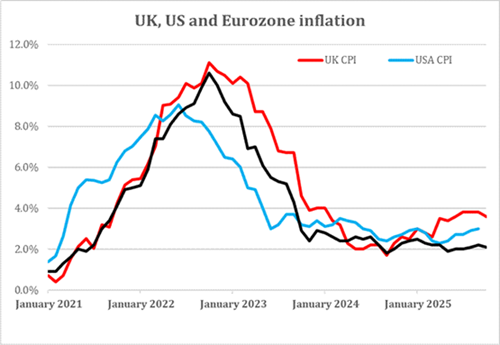
Source: ONS, FRED, Eurostat
CPI inflation for October was down 0.2% from the previous month at 3.6%. That is in line with market and Bank of England expectations. In its November Monetary Policy Report, the Bank of England said “[September inflation]… is likely to be the peak. Beneath the headline numbers, underlying price and wage pressures have continued to ease. Inflation is likely to fall to close to 3% early next year before gradually returning towards to the 2% target over the subsequent year.”
The 3.6% figure will give some small relief to the beleaguered Chancellor, as she has recently been placing emphasis on reducing the cost of living in the Budget. Her measures are expected to include cuts to gas and electricity bills, although, notably, yesterday’s Financial Times contained an interview with Huw Pill, the Bank of England’s chief economist, saying that such one-off measures as removing 5% VAT would be looked through when making rate-setting judgements because the Bank’s target viewpoint is two years out.
The UK CPI reading was up 0.4% between September and October, 0.2% less than in the corresponding period of 2024. The CPI/RPI gap remained at 0.7% with the RPI annual rate also falling by 0.2% (to 4.3%). Over the month, the RPI index rose by 0.3%.
The Office for National Statistics (ONS)’s favoured CPIH index was down 0.3% at an annual 3.8%, reducing its historically wide margin above the CPI. As we have regularly said in recent months, a large part of that excess is due to the owner occupiers’ housing (OOH) category, which has a 17.1% weighting in the CPIH but is absent from the CPI. The OOH inflation rate dropped 0.4% to 4.8%, 3.2% off its peak January 2025 level and back to the level last seen in August 2023.
The ONS attributed the stable CPIH inflation to:
Main downward drivers
Housing and household services. The 12-month inflation rate for housing and household services was 5.0% in October 2025, down from 5.9% in September. On a monthly basis, prices rose by 0.5% in October 2025, compared with a rise of 1.3% a year ago.
Ironically, the main impact was from October’s Ofgem 2.2% quarterly price cap increase, which replaced an increase from a year ago of 9.5%. For gas, prices rose by 2.1% in the 12 months to October 2025, compared with a rise of 13.0% in September 2025, whereas electricity prices rose by 2.7% in the 12 months to October 2025, compared with a rise of 8.0% in September 2025.
Restaurants and hotels. The 12-month inflation rate for this division was 3.8%, down from 3.9% in September. On a monthly basis, prices were little changed in October 2025, compared with a rise of 0.2% a year ago. The largest downward effect came from accommodation services where monthly prices fell by 2.2%, compared with a fall of 0.2% a year ago.
Transport. Prices in the transport division rose overall by 3.8% in the 12 months to October 2025, the same rate as the 12 months to September. On a monthly basis, prices were little changed in October 2025, compared with a rise of 0.1% a year ago. The largest downward effect came from air fares, which rose by 1.7% between September and October 2025, against 6.3% between September and October last year.
As the Chancellor contemplates the first fuel duty increase since October 2010, the largest upward effect came from motor fuels, with petrol up 0.7p a litre over the year and diesel up 3.9p a litre.
Main upward driver
Food and non-alcoholic beverages. The 12-month inflation rate for food and non-alcoholic beverages was 4.9% in October 2025, up from 4.5% in September. On a monthly basis, food and non-alcoholic beverages prices rose by 0.5% in October 2025, compared with a rise of 0.1% a year ago.
Five of the twelve broad CPI divisions saw annual inflation increase, while six fell and one was unchanged. The categories with the highest annual inflation rate were Education (7.6%), Alcoholic beverages and tobacco (5.9%) and Housing, water, electricity, gas and other fuels (5.2%).
Core CPI inflation (CPI excluding energy, food, alcohol and tobacco) fell 0.1% to 3.4%. Goods inflation fell 0.3% to 2.6%, while services inflation, a focus for the Bank of England, was down 0.2% at 4.5%.
The ONS restarted the issue of its Producer Price Inflation indices last month, but says that “The accredited official statistics status of these statistics is suspended, pending a review by the Office for Statistics Regulation.” With that caveat in mind:
· Producer input prices rose by 0.5% in the year to October 2025, down from a revised rise of 0.7% in the year to September 2025.
· Producer output (factory gate) prices rose by 3.6% in the year to October 2025, up from a revised rise of 3.5% in the year to September 2025.
Comment
The Bank of England’s next interest rate decision is on Thursday 18 December. If anything, the October inflation numbers increase the likelihood that the Bank will opt for a 0.25% cut, although the decision will also be influenced by the contents of the Budget. A smorgasbord of tax rises will have less impact on bringing down inflation than a (supposedly now abandoned) increases to income tax rates.
HMRC Pension Scheme Newsletter 175 - November 2025
Pension Scheme Newsletter 175 covers the following:
· Autumn Budget 2025
· collective money purchase schemes
· defined benefits surplus payments
· Inheritance Tax on pensions
· changes to tax rates for property, savings and dividend income
· salary sacrifice reform for pensions contributions
· speculation about budget changes
· checking your pension protections and enhancements service
· reporting a transfer to a qualifying recognised overseas pension scheme (QROPS)
Areas of particular interest:
Autumn Budget
The newsletter provides a summary of the pension related announcements in the Budget
1. Collective money purchase schemes
The Government will introduce new legislation to allow unconnected multiple employer collective money purchase schemes. The legislation will give HMRC the powers to register the schemes or refuse them.
The new rules will be in the Finance Bill 2025, however, in order to be operational, the schemes will also need separate legislation from the DWP to take effect.
2. Defined benefits surplus payments
New rules will be introduced from 6 April 2027 which will allow defined benefit schemes with surplus assets to make direct payments to members or other beneficiaries. The payments will need to be permitted in the scheme rules and are subject to trustee discretion.
The payments will be treated as authorised payments and taxed as pension income at the individual’s marginal rates. To benefit from the payments, members must have reached the normal minimum retirement age.
3. Inheritance Tax on pensions
From 6 April 2027 most unused pension funds will form part of the member’s estate on death. Personal representatives will be liable for reporting and paying any Inheritance Tax due on unused pension funds and death benefits. Where personal representatives expect Inheritance Tax to be due, they can direct pension scheme administrators to withhold 50% of the taxable benefits for up to 15 months from the date of death. Personal representatives can then direct pension scheme administrators to pay the Inheritance Tax due to HMRC from the benefits that have been withheld before releasing the rest of those benefits to the pension beneficiaries.
This will not apply to exempt beneficiaries, benefits under £1,000 or continuing annuities.
Personal representatives will also be discharged from liability for any pensions which are discovered after they have received clearance from HMRC.
These rules will be included in the Finance Bill along with other amendments resulting from HMRCs consultation. HMRC state that further guidance will be made available in due course.
4. Salary sacrifice reform on pension contributions
From April 2029 the government will limit the National Insurance advantages of using pensions salary sacrifice to £2,000 of contributions a year.
Employees can continue to contribute more than the £2,000 through salary sacrifice but contributions above £2,000 will have National Insurance contributions applied in the same way as other employee workplace pension contributions.
The rules will apply to new and existing salary sacrifice schemes.
HMRC will work with the pension industry and employers on the implementation of this new restriction. They will legislate in due course.
Checking your pension protections and enhancement service
HMRC have renamed their ‘Check your pension protections’ service ‘Check your pension protections and enhancements’.
Individuals will now be able to view all their protections and enhancements online and submit amendments to some protections.
Application and amendments for enhancements will remain paper based.
NHS pensions savings statements have started to arrive
(AF8, FA2, JO5, RO4)
A fresh set of brown envelopes will have arrived in the post for many NHS medical consultants over the last few weeks. These will include the pension inputs for both tax years 2023/24 and 2024/25. The 2023/24 figures have been delayed for a year due to the administrative complications caused by the McCloud remedy.
Where individuals are members of both the final salary section and a career average (CARE) sections, they will receive two separate envelopes with two sets of figures. The figures need to be combined and tested against the individual’s annual allowance.
Often the envelopes can fill clients with dread as they will contain news that they have exceeded the annual allowance and there is a tax charge to pay. For the highest earning individuals who are subject to annual allowance tapering, then, unfortunately, this is likely to still be the case. However, for those with taxable earnings below £200k and, so, not subject to taper, there may be some good news as outlined below.
2023/24 tax year
From 2023/24, a new rule was introduced to help high earners in public sector schemes such as the NHS. The rule allows the negative inputs in a final salary section of the scheme to offset the positive inputs in a CARE section.
When calculating the pension input for a defined benefit scheme there is an allowance used which aims to remove the inflationary element in the notional ‘growth’. For tax year 2023/24, HMRC’s pension input calculation will use the inflation figure to September 2022 - 10.1%.
In simple terms, this means that consultants with a pay increase of less than 10.1% in that tax year will have a negative pension input in their final salary section of the scheme. (There is no further accrual in the final salary schemes – benefits only change with salary changes). For most the pay increase was likely to be significantly less than this, meaning the new rule can be used immediately to offset some or all of the positive inputs in the CARE scheme. Note the minimum overall input is still limited to zero – i.e. people can’t carry forward a negative figure.
Example
|
2023/24 Final salary input |
- £30,000 |
(shown on the statements in brackets) |
|
2023/24 CARE input |
£40,000 |
|
|
Total input for 2023/24 |
£10,000 |
|
Assuming the individual is not tapered, they can carry forward the £50,000 of unused allowance to future years.
Because of the delayed pension savings statements, many will have estimated their pension inputs for tax year 2023/24. Any individuals who have provided an estimate will need to review this and make any adjustments to their 2023/24 tax returns. Any individuals who now have a tax charge, and didn’t declare anything previously, will now need to do so.
2024/25 tax year
There was recently a review of NHS consultant’s pay and pay scales. Many received substantial pay increases, and these are reflected in the 2024/25 inputs. However, the positive news is that the inflation figure used for calculating the 2024/25 inputs, i.e. to September 2023, was still relatively high at 6.7%. This will offset a significant proportion of the ‘growth’ in value.
Even so, those who benefited the most from the review are likely to see pension inputs in excess of £100k. However, as explained above, for many, these may be able to be offset against the carry forward available from 2023/24.
Where the individual’s Threshold Income exceeds £200,000, remember, the full value of the pension input needs to be added to their taxable income to reach the Adjusted Income figure. The large inputs in 2024/25 may lead to significant reductions in the annual allowance.
Excesses
Where there is an excess, individuals have the option to either pay the tax directly to HMRC with their own funds or to elect to use scheme pays.
In either case, individuals must declare the excess in their self-assessment – SA101 Pensions savings tax charges, Box 10. If they are using scheme pays, they also need to complete Box 11 to state how much tax the scheme will be paying.
Where scheme pays is used, the tax charge is applied as a debt against benefits held in the scheme. The debt rolls up with interest, which is currently CPI plus 1.7%*. The debt is then converted into a reduction in benefits when they are taken. As it reduces the level of guaranteed pension for life, careful consideration should be given before making any election.
*This relates to the rules for NHS England. Similar rules apply to the scheme pays rules in other UK countries. NHS Wales, Scotland and Northern Ireland all have separate but very similar NHS pension schemes